Back on April 26, the utility infielder Gift Ngoepe, from South Africa, became the first African-born player in the major leagues—or so one might have thought. If you consider the Canary Islands a part of Africa, then Ngoepe missed out on being the first African big leaguer by more than a century.
Alfredo Cabrera, legendary Cuban shortstop and a native of the Canary Islands, an archipelago off the coast of Morocco belonging to Spain, appeared briefly for the St. Louis Cardinals in 1913. Since Cabrera went 0 for 2 in his one game in the National League, Ngoepe, who singled in his first bat, does have the distinction of being the first African to get a hit in the big leagues.

As middle infielders mostly known for their defense, Ngoepe and Cabrera actually have a little in common. Cabrera was about an average hitter in the Cuban League of his time (with a 95 OPS-plus). Although he only had two at bats in the actual major leagues, in 47 games and 160 at bats against big league teams visiting Cuba Cabrera slashed .238/.282/.275, for an OPS-plus of 80.
But Cabrera was not the first native African to play professional baseball. To find out who that was, we have to look back into the 19th century, all the way to the first “Negro league”—that is, the first professional baseball league with national ambitions set up expressly for African American ballplayers: the National Colored League of 1887. The NCL was actually a member of “organized baseball,” as it signed the National Agreement—a necessary precaution, since the Agreement protected the league’s clubs against raids by other leagues, and in the mid-1880s minor league teams were beginning to hire black players.*
The National Colored League’s rosters at the beginning of the season were published in The Sporting Life.

There’s a lot of interesting stuff here—for example, Sol White and F. C. Leland both showing up on the roster for the Capital Citys of Washington, D. C. That team would never play a game, but Sol White transferred to the Pittsburgh Keystones and of course went on to a Hall of Fame career as a player, manager, and historian. Frank Leland moved to Chicago, where he became better known as a promoter and manager than as a player himself, running the Union Giants, Leland Giants, and Chicago Giants for many years.
But let’s focus on the Lord Baltimores, particularly “J. H. Wilson.” The NCL only lasted about two weeks; Wilson appeared in all six of the Lord Baltimores’ league games for which we have found box scores, batting .296/.321/.444, mostly as an outfielder.
A few NCL players, such as Leland, White, William H. Malone (of the Keystones and later Pythians), or William H. Selden (of the Resolutes) went on to long careers in professional baseball—but most of them disappeared back into the obscurity from whence they had emerged. For many, there’s little known other than their names.
So, coming across even a few details about an otherwise utterly unknown player like J. H. Wilson of the 1887 Lord Baltimores qualifies as a real find. An article in the Philadelphia Times (January 30, 1887) discusses the NCL’s Philadelphia entry (called the Pythians after the preeminent early black baseball club in the city). At one point the unnamed writer laments the Pythians’ failure to sign some Lincoln University students who had instead hooked up with other NCL clubs—then goes on to give a little detail about the life of one of these student-ballplayers:

The Bassa people live in West Africa, in Sierra Leone and the Republic of Liberia. Lincoln University, an historically black college located in Chester County, Pennsylvania, had a long-standing relationship with the American Colonization Society, the organization that originally established Liberia as a colony of freed slaves from the United States.
And in fact we can find news of three Liberian youths, educated at Lincoln, returning to their native country in 1884—among them a young man named James W. Wilson:

Wilson arrived back in New York, on board the same ship (the Monrovia) that had taken him to Africa, on February 20, 1885, with the United States listed as his “permanent” destination—closely matching the story told about Jim Wilson in the Philadelphia Times nearly two years later:


The catalogues for Lincoln University in the 1880s, 1890s, and 1900s have been scanned and put online. They include lists of students and faculty each year. Here’s a page from the 1880-81 catalogue showing James W. Wilson of Cape Mount, Liberia, along with six other Liberian students:

Looking through the catalogues, James W. Wilson graduated with an A.B. in 1882. As we know, he visited Liberia in late 1884 and returned in February 1885. He then undertook study in the theological department, and graduated with an S.T.B. (Bachelor of Sacred Theology) in 1888. On April 18, 1887, just a couple of weeks before the National Colored League season started, he gave a speech at Lincoln University’s commencement on “Liberia and its Native Tribes.” That summer, after the league had collapsed, Wilson spoke at a celebration of the 40th anniversary of Liberian independence:

I don’t know what happened to James W. Wilson after 1888—whether or not he returned to Liberia, whether he continued to play baseball. But we can trace his life back before his matriculation at Lincoln University.
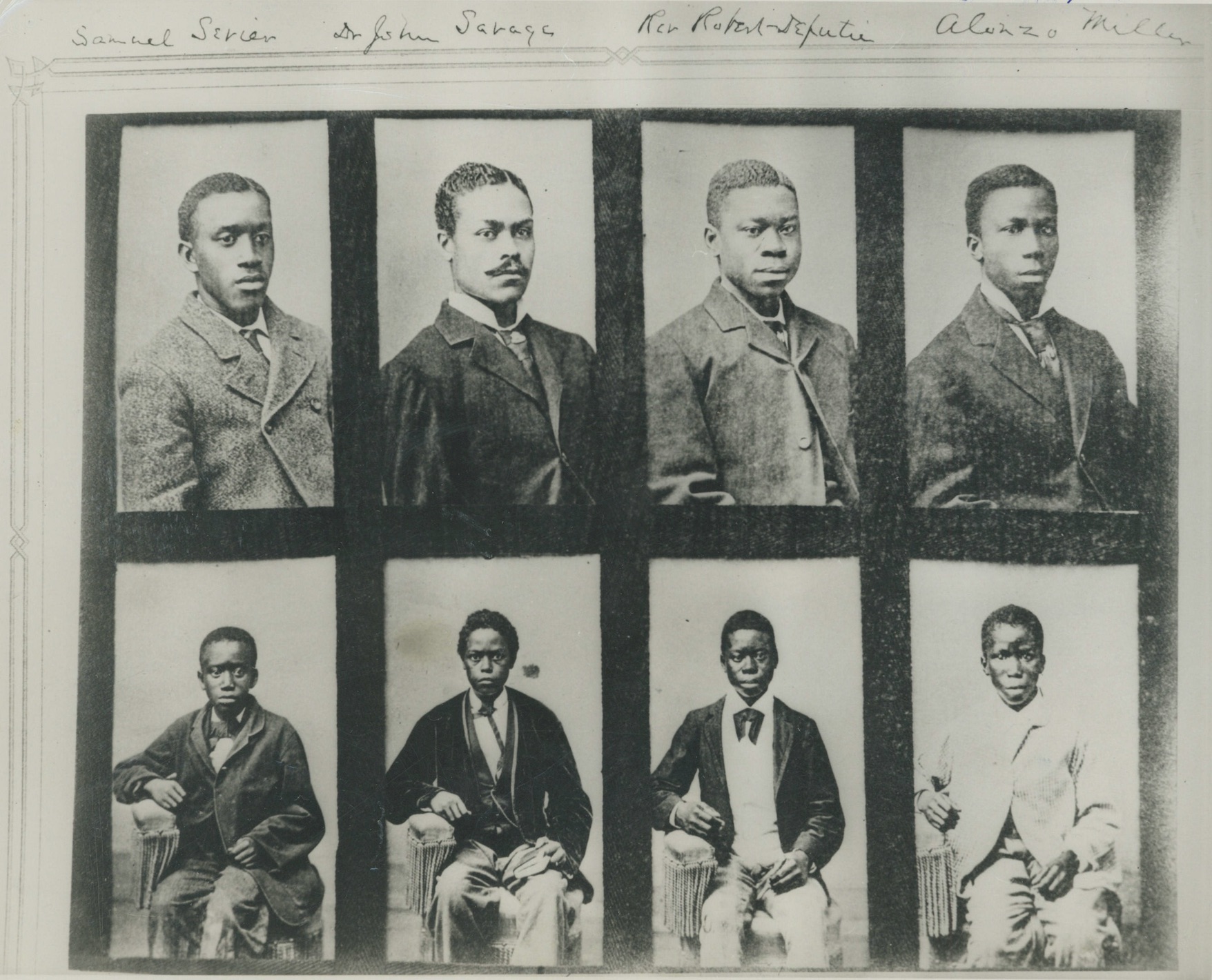
He was part of a group of ten Liberian youths brought to Lincoln University in 1873 with some fanfare. One of the earliest and most extensive press accounts I’ve found, in an African American newspaper called the Pacific Appeal (published in San Francisco), includes quite a bit of detail, and offers a slightly different account of the origins of James W. Wilson:

Here are photographs of four of the Liberian students, showing them as adults, and below that, as children when they first arrived in the United States. (Unfortunately Wilson is not included.)

According to the account in the Pacific Appeal, James W. Wilson was of “Congo” rather than “Bassa” origin. It seems likely that the Appeal was referring to the Congo river basin, located on the Atlantic coast of Central Africa, perhaps (though not necessarily) the Kongo people specifically.
Wilson’s father was rescued from a slave ship by an American naval vessel, a part of the Africa Squadron set up to suppress the trans-Atlantic slave trip. Due to lackluster support from the U.S. government (which was largely compromised by the Southern slave power), the Africa Squadron achieved only intermittent success for most of its 1842-1861 existence—until the final years before the Civil War. In 1859 and 1860 seven slave ships were caught in the Kongo region.
The Naval History Blog gives a detailed account of the “sloop of war” U.S.S. Constellation’s capture of the slave ship Cora in 1860. Wilson’s father may or may not have been aboard this particular ship, but its story gives a good idea of what he might have experienced:
Cora flew no flag but when she ignored Constellation’s warning shots, the flagship gave chase. The 431-ton barque raced along the coast in a frantic attempt to make it out to the open water. Her crew threw over hatches, spars, and boats to lighten her load but could not out-sail the sloop. After firing several more shots, the last of which cut away part of Cora’s running rigging, the slaver finally hove to and was boarded. The boarding party, led by Lt. Donald McNeil Fairfax, immediately discovered the slave deck and the human cargo within.
Ordinary Seamen William Ambrose Leonard recalled, “The scene which here presented itself to my eyes baffles description. It was a dreadful sight. They were all packed together like so many sheep; Men, Woman, and Children entirely naked, and suffering from hunger and thirst. They had nothing to eat or drink for over 30 hours. As soon as the poor negroes were aware that we were friends to them, they commenced a shouting and yelling like so many wild Indians. They were so overjoyed at being taken by us that I thought they would tear us to peices [sic].”
Master Thomas Eastman and a prize crew of eleven sailors and three marines sailed Cora to Monrovia to deliver the 694 surviving Africans to Reverend John Seys, the United States Agent for Recaptured Africans in Liberia. Many of them were apprenticed to saw mills and cared for by local Liberian families. As captured Africans were forcibly taken from all over the interior of the continent, there was no single “home” to return them to and American officials feared that returning the Africans to the Congo River basin would result in their recapture.
There are some early professional black ballplayers who were likely born into slavery (several of the 1886 Cuban Giants, for example, were born in Virginia or D.C. before the Civil War). But in Jim Wilson we see only a generation’s separation between the Negro leagues and the Middle Passage.
*-UPDATE 6/15/2017 Ken Mars and Richard Hershberger inform me that the NCL was apparently NOT allowed into the National Agreement in the end. Here’s the relevant item (from The Sporting Life, February 23, 1887), courtesy of Ken:

UPDATE 6/29/2017 See comments for fantastic research by Reg Pitts into the rest of Wilson’s life (he spent it in the United States). Also, I have added a page from the Lincoln University catalogue for the 1880-81 school year that I had forgotten to include.


Leave a Reply