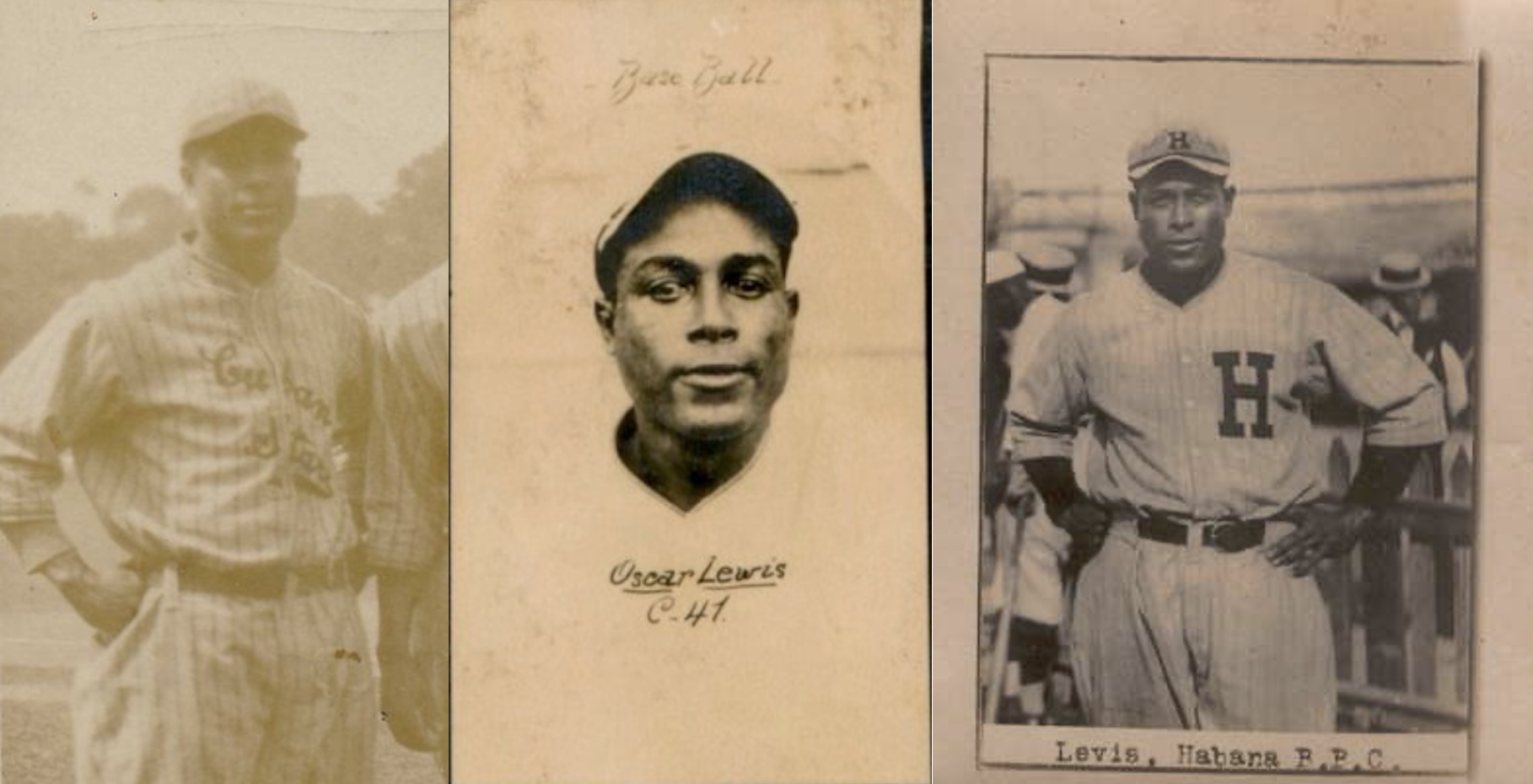

Oscar “Chick” Levis (often appearing in box scores as just “Oscar” or “Oscal”) was a spitballing sidearm pitcher in Cuba and the Negro leagues in the 1920s. He was very good but not great—about a .500 pitcher in the Negro Leagues (56-53), better than that in Cuba (48-38 according to Figueredo). Seamheads has him with an ERA-plus of 117 in the Negro leagues, and 116 in the three Cuban seasons we’ve got so far. Perhaps his highwater mark was in the 1927/28 Cuban League, when he went 7-2 for the champion Habana club, and finished second in strikeouts to Willie Foster.
The well-known semipro catcher Paddy Smith, who played against Levis and the Cuban Stars (and other black teams) many times, had high praise for him in an interview with the Brooklyn Eagle in 1928:
As a catcher and as a hitter, Paddy Smith sees plenty of semi-professional pitching. He rates one of the semi-pros as a sure-fire success if he ever landed in the majors. That man is Oscal [sic], a burly right-handed ace of the Cuban Stars—a Negro, which automatically bars him from organized baseball under an unwritten rule.
“Oscal is as good a pitcher as you’ll find anywhere,” was Mr. Smith’s flat remark. “He has everything—speed to burn, curves, and perfect control. I wouldn’t rate any pitcher I ever saw above him.”
Paddy Smith’s opinion on the subject was so forceful that your reporter made a mental resolution to see him if the opportunity ever arises. (Brooklyn Eagle, October 16, 1928, p. 4A)
After Levis stopped pitching he managed the 1930s Cuban Stars club that was based in New York City and owned by Nat Strong and Max Rosner (not to be confused with Alex Pompez’s New York Cubans). Levis was also mixed up in the numbers racket with Pompez, which resulted in some brushes with the law, but by the 1940s he was running his own business in Harlem, Chick’s Bar and Grill. He eventually moved to Virginia, where he passed away in 1983.

Levis is usually understood to be from Panama. His Panamanian identity is mentioned in passing in some Cuban sources, such as Figueredo’s Who’s Who in Cuban Baseball (p. 399), in Roberto González Echevarría’s The Pride of Havana (p. 172), and in Severo Nieto’s Early U.S. Blackball Teams in Cuba (p. 155). George Palmer, a columnist for the New York Amsterdam News, called Levis “Panama-born” in 1947. James Riley’s Biographical Encyclopedia, however, assumes that Levis was Cuban. He’s not mentioned in the very short Panama section in William McNeil’s Baseball’s Other All-Stars. And I don’t think I’ve ever seen anybody make a big deal out of Levis being (as he apparently is) the first professional ballplayer from Panama to play in the United States. (His BR Bullpen entry does point out that he was the first non-Cuban Latin player in the Cuban League.)
What has gone completely unremarked until now, though, is that Levis was not actually born in Panama. His real name was Oscar Joseph Levy, and he was born in Jamaica. I’ll go through the evidence.
The 18-year-old Levy first arrived in the United States on August 22, 1918, on board the SS Santa Elena. On the passenger list his nationality is listed as “BWI” (British West Indies), and his permanent residence as Balboa, Panama. His nearest relative is his mother, Theodosia Foreman, of Ancón, Panama Canal Zone. His birth place is listed as “D.W.I. Jamaica.” (“D.W.I.” is probably a mistake for “B.W.I.”


Less than a month later Levy registered for the World War I draft. On the card he is identified as a British citizen. He was working for the Submarine Boat Corporation at the Newark Bay Shipyard.

He appears in the 1920 census (enumerated in January) living in Manhattan and working as a chauffeur for a private family. His birth place (and that of his parents) is listed as Panama. He may at this point already have been a student at City College. George Palmer, writing in 1947, described his early years in this country, calling him “Oscar Levy, better known as ‘Chick’ of Chick’s Bar and Grill, up at 145th St. and 7th Ave.”:
Chick, a Panama-born baseball player of not so long ago, is well known in the community. He played ball 18 years with the Cuban Stars before his retirement in 1938, He lived in Cuba for a long period and claims he holds several records in Cuba which still stand. He got into baseball quite unintentionally. While a second year student attending City College he went out to Philadelphia for a tryout. The tryout lasted 18 years. He found ball playing lots of fun and made a good living out of it. (New York Amsterdam News, December 13, 1947, p. 26.)
He joined Alex Pompez’s eastern Cuban Stars in 1921, and played ball in Cuba every winter for years, beginning with Almendares in the 1922/23 winter season. Upon his return to the U.S. with Pompez’s team in April 1924, he appears as “Oscar Levis” in the passenger list, the earliest mention I’ve seen of the “Levis” name in official documents.

By June 1925, when he appears in the New York State Census, he is married, and still listed as a chauffeur rather than baseball player. He also gives his name as “Levis.” In the same month, while in Atlantic City with the Cuban Stars, he mailed the following postcard to a writer at a Cuban newspaper, signing himself “Levis”:

In 1926, he petitioned to become a naturalized citizen, under his legal name (Levy). His application gives his birthdate as August 7, 1899, in “Jamaica BWI,” and confirms his arrival in the U.S. in 1918 aboard the Santa Elena. He renounces his allegiance to George V, “King of Gt. Britain & Ireland.” Levy’s occupation is given as chauffeur—but his witnesses are Nathaniel C. Strong and Max Rosner, both baseball promoters who controlled booking for the Cuban Stars (and would later own the Cuban Stars club Levis managed in the 1930s).


A few years later, in the 1930 census, he is listed as Oscar Levis (wrongly transcribed at both Ancestry.com and Family Search as “Oscar Lewis”), born in the British West Indies, and his occupation is (finally) listed as “ball player, Baseball team.” Under “naturalization” the census form says “No” for Levis. This could be a mistake—or maybe, for some reason, his petition for naturalization was denied.


In the 1940 census he is Oscar J. Levy, restaurant manager, born in Jamaica BWI…but his citizenship is given as “Pa,” presumably Panamanian.


Lastly, his death certificate lists his birthplace as “West Indies”:

Oscar Levy’s parents were Amos Levy and Theodosia Foreman. I haven’t been able to track anything down about his father, but his mother was mentioned on Oscar’s World War I draft card (above), and she traveled to the U.S. in 1936. She was visiting her son, who’s listed as her contact on the passenger list—which also gives her birth place: Jack’s River, Kingston, Jamaica, as well as her mother’s name (Mrs. Susan Norris of Jamaica). It’s a bit unclear where this “Jack’s River” is located. There are places named Jacks River in St. Mary Parish, north of Kingston (and adjacent to it). I haven’t found a record of Oscar’s birth or any other, more specific information about it.


A few other Negro league figures were connected to the English-speaking Caribbean, but not many. Alexander McDonald Williams, the co-founder and owner of the Negro National League’s Pittsburgh Keystones and builder of the Hill District’s Central Baseball Park, was an immigrant from Barbados. Alphonso Gerard, a 1940s outfielder, was born in 1917 in what used to be the Danish West Indies, just a couple of months after it became part of the U.S. Virgin Islands. The 1920s Royal Giants outfielder Irvin Brooks was long thought to have been from the Bahamas. He was really born in Key West, Florida, but his family probably did have Caribbean connections.
A handful of major league ballplayers were born in Jamaica, most notably Chili Davis and Devon White. While it seems likely that he grew up in Panama, Oscar Levis is (so far) the only Negro leaguer known to have been born in Jamaica.

UPDATE 2:56pm: Thanks to commenter JohnR, I was able to find Oscar’s birth registration in Jamaica. He was born on August 7, 1898 (rather than 1899), in Oracabessa in St. Mary Parish.


Leave a Reply