For the last player discussed in my December 2024 talk for the Josh Gibson Foundation, I reached back into some much earlier research. This is a player I had already written about, all of 14 years before (now more than 15), at Gary Cieradkowki’s Infinite Baseball Card website, but I think the story very cool, still not especially well-known, and quite relevant today. Again, slides were created by my wife Christina Chia. (This post was originally published in the Agate Type newsletter.)

Basilio Cueria was a big, powerful ex-soldier who had been a baseball prodigy from the time of his childhood in Marianao, a suburb of Havana. He was an all-around player, a catcher who could also play the outfield and first base, and even filled in at second and third occasionally.

The owner of one of his teams, the promoter Syd Pollock, even hyped him as “Babe Ruth Cueria”—but despite his potential, he never hit enough to break out of the Cuban traveling clubs in the United States during the 1920s, when he wasn’t working in a Long Island factory. So how did this Afro-Cuban immigrant, journeyman ballplayer, and blue collar worker become the subject of admiring profiles by two of the twentieth century’s greatest poets?
Cueria may not have been not a great ballplayer, but he was an ardent opponent of dictators and would-be dictators. He came to the United States in 1921 to play baseball with Abel Linares’s All-Cubans team, then became involved with Cuban émigrés who opposed the authoritarian governments of Gerardo Machado and Fulgencio Batista. Cueria wound up more or less exiled from Cuba for the better part of two decades. After retiring from pro baseball, he organized an amateur team in Harlem called the Julio Antonio Mella Baseball Club, named after the founder of the Cuban Communist party, who had been assassinated in Mexico.
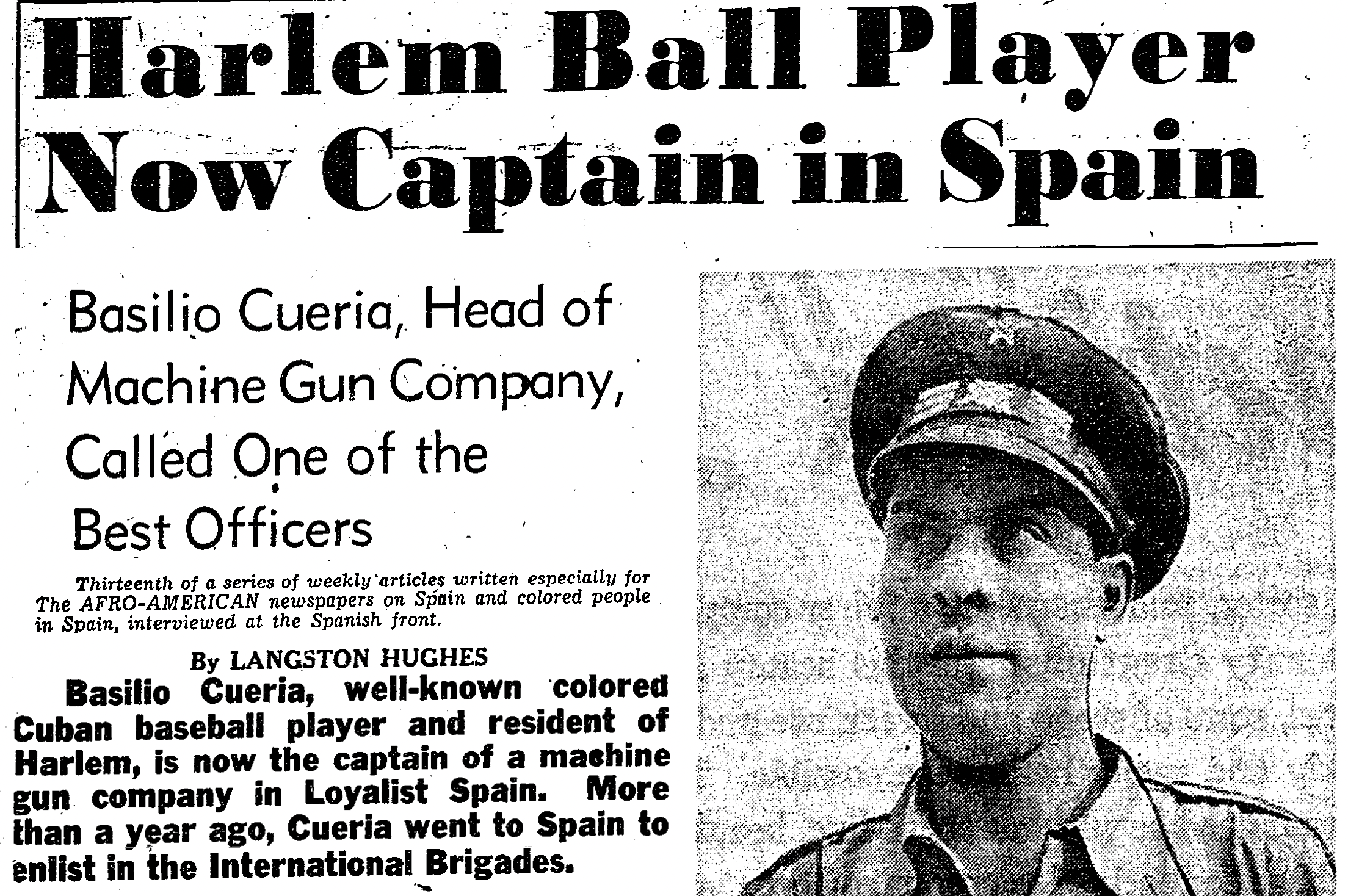
At two in the morning on January 20, 1937, Cueria arrived in France aboard the S.S. Berengaria, then secretly made his way overland to Spain, where he joined the Abraham Lincoln Brigade—American volunteers fighting on behalf of the Spanish Republic against the fascist rebels led by Francisco Franco. During his first year in Spain Cueria survived trench warfare at the Battle of Jarama and artillery and air bombardments at Brunete. He transferred to the regular People’s Army, and rose to the position of artillery captain under the famous peasant general Valentín González, known as “El Campesino.”

That fall Nicolás Guillén, the greatest Cuban poet of the twentieth century, traveled to Spain as a magazine correspondent. Looking to interview Cubans in the Republican forces, he quickly found his way to Cueria, whom he remembered as catcher for the Marianao club in the Cuban League. Now, Guillén wrote in the leftist journal Mediodía, Cueria had “exchanged the diamond for the trenches,” and “the ephemeral glories of baseball championships” for “the higher glories of fighting fascism.”
Guillén also introduced Cueria to the American poet Langston Hughes, who was reporting on the Spanish war for the Baltimore Afro-American. Hughes described the former Cuban Star as a “tall fine looking captain who was immensely popular with the officers and men under his command.” Cueria, Hughes said, was trying to teach baseball to Spanish soldiers, and was looking forward to returning home to New York, where his family still lived. “Our side is sure to win,” he said. “We can’t let the Fascists put it over on us. They’d put all the worst old prejudices back into force and probably even introduce new ones, like Hitler and his Aryanism in Germany. No, we’re not going to let them win!” He asked Hughes to “tell the Mella Club to keep up that team in Harlem, so I can play with them when I get back. Tell all those Harlem baseball players hello!”


Guillén’s interview shows a more pensive side of the soldier/ballplayer. He asked Cueria about his plans for the future, and whether he intended to come home to Cuba. “Look, I can’t say anything about the future,” Cueria replied. “I’m no fortune-teller. But my thinking now is to return to Cuba when this is done, when we’ve won, and it’s safe. And nothing gives me greater hope than the possibility of seeing people who are dear to me, people I haven’t seen for a long time. My friends, my teammates, like Oms, Fabré, José María Fernández…” He fell silent. Then, as if talking to himself, Cueria murmured: “If they don’t kill me, I’ll come back.”
He did return to Cuba. Franco had won by April 1939; records show that Cueria re-entered the United States from Havana in April 1940, so he may have spent a year or more looking up those old friends and teammates. But the Spanish Civil War was, of course, only the beginning. On October 26, 1942, Basilio Cueria, former captain in the Spanish Republican Army, enlisted in the United States Army—as a 43-year-old private. On July 22, 1943, based at Camp Rucker in Alabama, Private Cueria, listing himself as “Negro,” submitted a petition for naturalization as a United States citizen to authorities in Montgomery, Alabama—where, soldier or not, anti-fascist or not, he would have had to go to the back of the bus. Nor could he have voted, or exercised very many of the other rights he would supposedly gain as a citizen. Had he objected, he could have found himself beaten, arrested, even killed.

I don’t know where he served in the war, but Basilio Cueria, veteran of three armies, two wars, and ten years of professional baseball, died on May 8, 1959, aged 60, and was buried in Long Island National Cemetery.
To my knowledge Basilio Cueria was one of two major league players to have fought in the Spanish Civil War (the other being another Afro-Cuban ballplayer named Domingo Gámiz, also a member of the Mella Club and Cuban Stars pitcher, about whom far less is known).
So that wraps up my talk for the Josh Gibson Foundation, serialized in four parts (the first three are here, here, and here). The focus was on relatively obscure players, in order to show the range both of sources we can use to track them down—from draft records, photographs, and box scores to personal letters, literary journals—and of the walks of life players came from or moved into after their baseball careers: boxers, high school principals, college football stars, soldiers, dentists, and private detectives.
Leave a Reply