(Originally published in the Agate Type newsletter.)
Here are some notes on three of the players I’ve recently researched for the Seamheads DB.
1. Curtis Brinson (1938 Chicago American Giants)
For years Negro league historians have known about “Brinson,” an outfielder who appeared in one Negro American League game for the Chicago American Giants in the late 1930s. It was in Chicago on Monday, August 15, 1938, against the Atlanta Black Crackers:

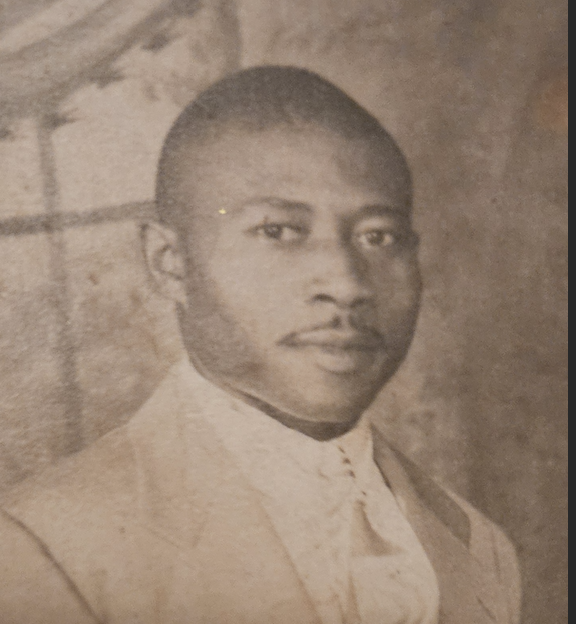
Nothing else was known about Brinson. Nobody found any notes in the Defender or elsewhere about a player joining Chicago for one game, where he might have come from, or even what his first name was. Until earlier this month, when Brea Duval wrote to tell me about her grandfather Curtis Brinson.
Here are some excerpts from a couple of Brea’s emails, reproduced with her permission:
He was born in Georgia and was a natural athlete. I don’t know the circumstances of how he ended up on the CAGs, but what my mom [his daughter] told me was that he only played the one game in 1938 because my great great grandmother told him he needed to get back to Georgia just because she didn’t want him traveling out of state. He ended up fighting in WW2.
She told me that he told her that he’d made the team. She definitely remembered that. She also talked about how much he loved baseball. When he was little he would be out in the fields, picking cotton, and then when they were done he’d run home and him and his brothers would play. She did confirm his mom was the one that told him he wasn’t allowed to stay with the team. He was only 18 or 19 when he made it and she was worried about his safety and the kind of life he might have as a professional baseball player with what was available to black men at the time.
We both felt really awful for how disappointed he must have been to be so close to realizing a dream only to have it taken away. But, my mom emphasized he was really, really good and seeing that he made the CAGs (I did a little research on them) also confirms that.
Curtis Brinson was born in 1916 (or according to some sources 1917) in Hazlehurst, Georgia. It’s certainly interesting that the Georgian native Curtis Brinson’s lone game for the American Giants was against a team from Georgia. One possibility is that he travelled north with the Black Crackers and was given a one-game tryout by Chicago before deciding to return home—though if that were the case you’d think he might have gotten into some games for the Black Crackers, and I haven’t been able to find anything like that. The game against the Black Crackers might just be a coincidence.
To my mind this is still one of the more thrilling aspects of the work we do: being able to substantiate and correctly honor the contributions of people who may have had only the briefest of brushes with fame, but still played crucial roles in the history of Black professional baseball.

2. Lloyd Scott (1934 Chicago American Giants)
When the American Giants went to spring training in New Orleans in March 1934, they took with them an infield hopeful named Lloyd Scott:

For a few weeks in May and June he got a shot as the American Giants’ regular second baseman, but in fact didn’t “mingle” very well with major league pitching. After that he was relegated to the bench with only occasional appearances. By late August he had been transferred to the Nashville Elite Giants, though he didn’t catch on there either. For the year he hit .197 against major Negro league pitching in games with box scores. Scott never appeared in the major Negro leagues again, and seemingly didn’t play high-profile minor league or independent ball either.
There was some mild difficulty researching him because a Black tennis player named Lloyd Scott emerged as a college player for Prairie View A&M in the early 1930s. The key proved to be the baseball player’s link to Alcorn College as a protegé of American Giants ace Willie Foster.
In 1932 the following note appeared in the Atlanta World, in a local news column for “Yazoo, Miss.”

This identified his home town, and from there it was easy to trace his life. Lloyd Cortez “L. C.” Scott built a career as an educator, spending 30 years as principal of the Friars Point Elementary School in his home state of Mississippi. His obituary doesn’t mention his brief baseball career.

3. Arnold Brown (1920 Detroit Stars, 1921 Chicago Giants)
A pitcher named “Brown,” no first name, appeared briefly for the Detroit Stars in 1920 and Joe Green’s Chicago Giants in 1921. This player sat there in Negro league reference works including the Seamheads DB for years with no progress. I had noticed a player named “Arnold Brown” who pitched for Steel Arm Taylor’s American Black Devils of Peoria, Illinois, in 1920.

I couldn’t link Arnold Brown to the Negro league pitcher, until I recently ran across this passage from a preview of a series between the Chicago Giants and Detroit Stars:

It turns out that Arnold Brown, the Peoria pitcher, was from Elgin, Illinois. Here is his World War I draft card, showing him employed by a barber shop in Elgin (the 1920 census shows he was a porter rather than a barber.) Interestingly he was blind in his right eye.

He had married his wife Gladys at the age of 19 and the couple had several children. By the 1940s the Brown family had moved to Cleveland. His World War II draft card says he has a “scar” presumably near his left eye and that his right eye is “partially blind.”


Later in life he switched his first and middle names around to go by “Richard Arnold Brown.” He passed away in Cleveland in 1972.
Leave a Reply