(Originally published in the Agate Type newsletter.)
When I wrote about Goldie Davis a couple of weeks ago, I started with this little item in the Baltimore Afro-American (April 11, 1924, p. 14):

Today we’ll go through a few of the eight rookies mentioned in the second paragraph, players brought to camp because the ABCs were losing almost all their established players to raids by ECL teams. Thomas (Pinky) Ward and Alex Evans will be left for future posts, as they are both fairly complicated (and, as of this writing, unresolved) situations. William Carter of Houston I know very little about beyond his birth date, and Howard Johnson of Chattanooga seems to have remained at the minor league or semipro level for his whole career. So in this post we’ll discuss “Adams Williams” from the West Coast, “Ernest Richard” of Omaha, and Henry Strickland of Chattanooga.
1. Adam (Black Cat) Williams (1924 Indianapolis ABCs)
Occasionally referred to as “Adams Williams,” Adam “Black Cat” Williams was an infielder for the Alexander Giants of Los Angeles from the winter of 1920 through the 1922 season, after which he played for the Los Angeles Colored Cubs in 1923. (He is very possibly in this photo of the Alexander Giants from July 1920.) He made the ABCs roster in April 1924, and started at second base a few times in league games (and at shortstop twice) before being supplanted by Namon Washington at second and Lawrence Davis and Ray Sheppard at short. His last appearance was on June 14.
Tracing him backward in time, his World War I draft card has him living in Beaumont, Texas, and working as a professional ballplayer for the Beaumont Black Oilers, owned or sponsored by the Phelan-Josey Grocery Company:

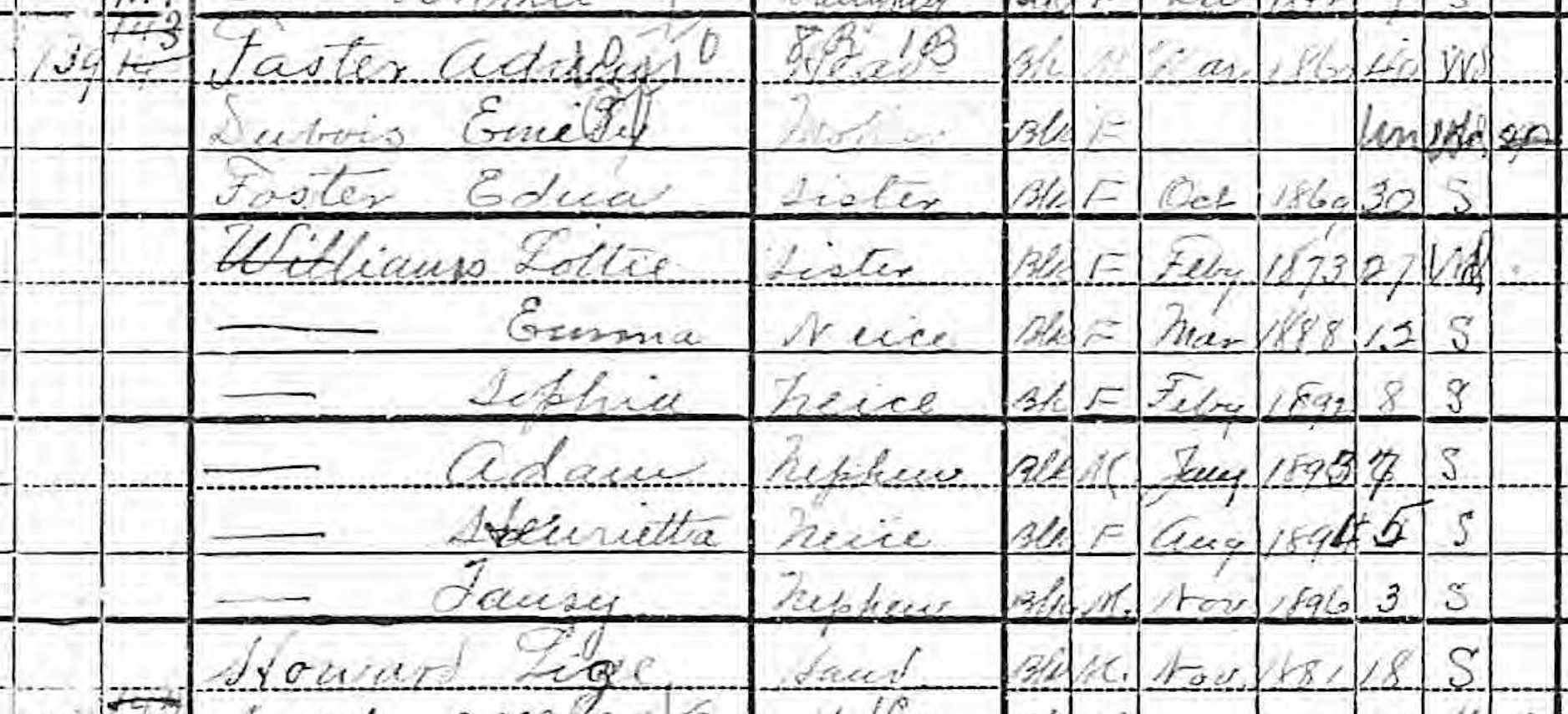
He can also be found in the 1900 census in Colorado County, Texas (site of Columbus), living with his uncle Adam Foster, his widowed mother Lottie Williams (Adam’s sister), and four siblings.

Williams was known in Beaumont as “Black Adam” or “Black Adams,” and almost always appeared as “Adams” in Beaumont box scores. He was regarded as one of the Black Oilers’ best hitters, playing shortstop and batting third for them from 1917 through 1919, before moving to Los Angeles.
I have not found him playing baseball after 1924, and in fact I haven’t been able to find him in any census or other records after 1917. (There’s an Adam Williams living in Jefferson County, Texas, in the 1920 census, but it’s unclear that this is the ballplayer.)
Also, as far as I know Adam “Black Cat” or “Black Adam” Williams had nothing to do with the earlier Texas infielder known as “Black Cat” who played for the San Antonio Black Bronchos 1907-1909 and 1911, and with the Dallas Black Giants in 1910.
2. Ernest Richie (1921, 1924 Indianapolis ABCs)
It quickly becomes clear that “Ernest Richard of Omaha” was really Ernest T. Richie. He appeared in one game for the ABCs in 1921 (box scores called him “Reggy”), then was called back for spring training in 1924, but didn’t make the team. This item in the Omaha New Era hints at what happened:

Born in Waxahachie, Texas, in 1895, to Will Richie (a day laborer) and his wife Georgia (a cook and washerwoman), Ernest Richie was living in Omaha as a young man in 1917, working as a driver for the Goodyear tire company. By 1919 he was playing for a local Black team, the Omaha Red Sox, and in 1920 he joined Gilkerson’s Union Giants. In 1921 Richie started the year with an Omaha team called the Green Goblins, but quickly rejoined the Union Giants. His one-game appearance with the ABCs occurred in Kansas City on May 28, when he came on in the second inning during a Monarchs rally and wound up losing the game, 11 to 9. He was back with the Union Giants in early June. In 1922 was reportedly the ace of the Gilkerson staff, winning 24 of 31 starts, and continued with them through the 1923 season before going to spring training with the ABCs in 1924.
Whatever illness or injury cut Richie’s time with the ABCs short, it may have affected his baseball career, as I’ve been unable to place him with any team until 1928, when he played for the Union Pacific team in Omaha’s Black semipro league. In 1932 he was pitcher/first baseman and captain of the Denver White Elephants, then a year later he was back in Omaha as manager and ace pitcher of the Union Pacifics. He lived the rest of his life in Omaha, along with other members of the city’s Black baseball community such as Charlie Mason, Goldie Davis, and Charlie Hilton, among many others.
3. Henry Strickland (1924 Indianapolis ABCs)
The first step toward identifying Henry Strickland after the Afro-American item on the ABCs was this article about old sandlot stars in Chattanooga:

The Chickamauga Club was based in Chickamauga, Georgia, just over the state line from Chattanooga. According to this article they developed into the Negro Southern League’s Chattanooga White Sox of 1926 and the Chattanooga Black Lookouts of 1927 and later. Here are the two passages that specifically mention the Strickland brothers:


Here the Strickland brothers are said to be cousins of the Henderson brothers, but I haven’t been able to substantiate that connection.
Horace “Strickling” (age 21, laborer in a foundry) and his brother Henry (age 18, courthouse janitor) can be found rooming together on Chickamauga-Tyner Road in the 1920 census.

Moving back 10 years, brothers Horace and Henry Strickland (ages 10 and 8, respectively) are in the 1910 census, living with parents Wiley and Mary Strickland and their sister Margie on Tyner Road.

Henry, age 28, shows up in the 1930 census living in Chattanooga with his wife Abbie and working as a porter in a public building. A World War II draft card from 1942 shows William Henry Strickland (the first time I saw his actual first name, which he apparently only used on some government records later in life), born in Shepherd, Tennessee, in 1902, and working at a TNT plant in Tyner, Tennessee. (Note that the draft registrar is Henry’s older sister Marjorie Strickland.)


Leave a Reply