(Originally published in the Agate Type newsletter.)
There are (as far as I’m aware) two team photos of the 1923 Indianapolis ABCs. Along with great images of some very well-documented players (Oscar Charleston, Dizzy Dismukes, George Shively, Connie Day), they also provide rare images of lesser-known players. In this post I’ll unpack how it’s possible to figure out who’s who in photos like this, where the identities of some of the subjects are not immediately obvious.
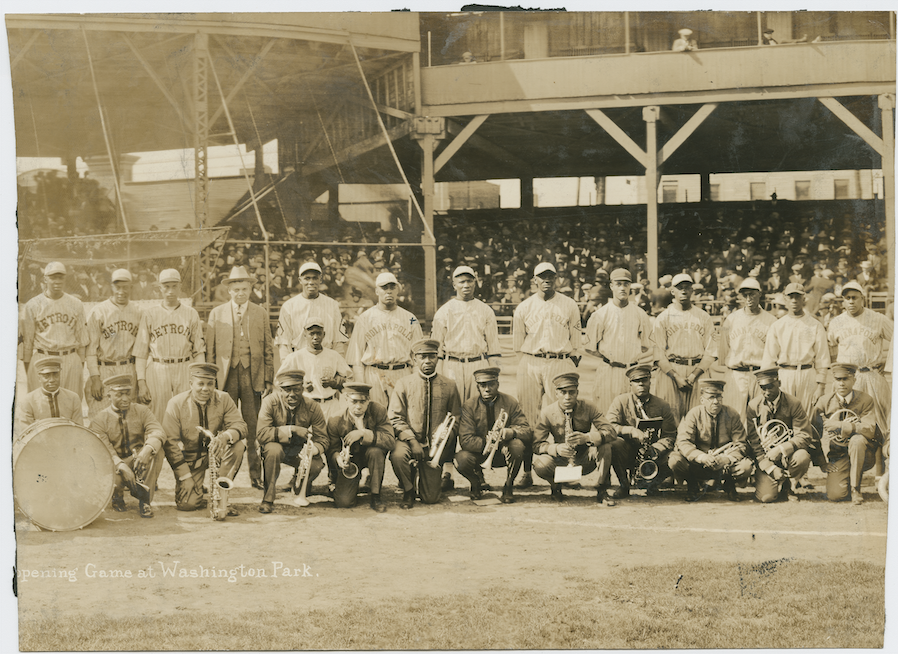
On April 29, 1923, opening day in the Negro National League, a Patton Studios photographer captured this image of the Detroit Stars and Indianapolis ABCs in Washington Park, Indianapolis. (Thanks to Graig Kreindler for the image, which he sent me years ago.)

It’s spectacular, showing a panoply of famous and obscure players, in addition to the members of a band that played and athletes who competed in track and field contests that day. It also provides a wonderful image of Washington Park and the crowd, and a picture of ABCs owner Olivia Taylor (inset on the top right).
For this post I’ll concentrate on the ABCs players (leaving the Detroit Stars for another time).


Among the ABCs players, starting to the right of the man in the suit (Detroit owner Tenny Blount), nine are easily identifiable: 1) Dizzy Dismukes; 2) Oscar Charleston; 3) unknown; 4) Henry Blackmon; 5) unknown; 6) unknown; 7) Connie Day; 8) Namon Washington; 9) George Dixon; 10) Larry Brown; 11) George Shively; 12) unknown; 13) Darltie Cooper.
That leaves four unidentified players: numbers 3, 5, 6, and 12.

The nine players I’ve identified in this photo all appear in the ABCs’ opening four league games (April 29 and 30 vs. Detroit, and May 5 and 6 vs. the Toledo Tigers). Conveniently enough, four more players appear for the ABCs in those games: Gerard Williams, Charles Corbett, Omer Newsome, and Charlie (Sensation) Clark. It seems reasonable to guess that these four might correspond to the unidentified players in the photo, though as we’ll see this hypothesis doesn’t entirely pan out.
Before we try to sort out which is which, let’s look at the other 1923 ABCs photo, taken in Kansas City during a series that lasted from May 30 through June 2—just a month after the panoramic photo was taken.

Here the obvious IDs are, standing L to R, 1) Henry Blackmon; 2) unknown; 3) Dizzy Dismukes; 4) Oscar Charleston; 5) unknown; 6) Connie Day; 7) Crush Holloway; and seated L to R, 8) George Shively; 9) unknown; 10) Darltie Cooper; 11) Namon Washington; 12) George Dixon.
As in the panoramic photo, there are nine “obvious” players in this one. Eight of them are the same, the one difference being the absence of Larry Brown (who had jumped to the Memphis Red Sox by this time) and the presence of Crush Holloway.
This leaves three unidentified players, players 2, 5, and 9:

These can be paired with three of the unidentified players in the panoramic photo:

A total of 11 players appeared in the ABCs-Monarchs series, with player-manager Dismukes also present, though he didn’t play. This matches the 12 players in the Miller photo. The box scores show the nine “obvious” players from the photo, plus Charles Corbett, Omer Newsome (who appears as “Duson” in one box score), and Gerard Williams.
Corbett is the easiest to figure out. Here is the first unidentified player, with the addition of an image of Corbett from a photo of the 1926 Harrisburg Giants (a bit faint, but you can still make him out).

I don’t have anything comparable for Newsome or Williams, but here is an image of three ABCs pitchers from June 1923.


Since one of the three has to be Newsome, it’s pretty clear that this must be him.
The third of the unidentified players to appear in both photos, and to play for the ABCs throughout the early part of 1923, must be Gerard Williams. He is one of the best known players—often mentioned and discussed in the Black press of the 1920s, and included in the “Honor Roll” (honorable mention) of the famous 1952 Pittsburgh Courier poll—who still remains to be identified in official records, and for whom I have never (to this point) found a usable image. (UPDATE: Thanks to Justin McKinney we do have his death date and place now.)

That leaves the last of the unidentified players in the panoramic photo. I originally thought he must be the pitcher Charlie “Sensation” Clark, who pitched for the ABCs on May 5, and had left the team by the end of May. But a comparison with the few known photos of Clark show that this is highly unlikely.


If it’s not Clark, who is it? Unfortunately I can only speculate at this point. There was a local catcher named Ballinger (no first name) who was with the ABCs for much of spring training, but by mid-April was already reported as likely to be cut. A first baseman named Gray from Winston-Salem, North Carolina, was mentioned once in an early list of ABCs recruits. (He may have been the same as G. E. Gray, a military veteran who had been a 25th Infantry teammate of Bullet Rogan, Dobie Moore, and company, and who had gone to spring training with the American Giants; but I don’t know this for sure.)
I would suspect that the unknown player was probably a pitcher, as there were only four in the photo (Dismukes, Cooper, Newsome, Corbett). Jim Jeffries, ace of the staff the past few seasons, was absent most of the 1923 season, probably with an injury or sore arm. Our mystery player might have been someone given a late chance who didn’t make it, and wound up replaced within a few days by the college star Sensation Clark.
Leave a Reply