(From the Agate Type newsletter)

Jim Willis was a pitcher in the late 1920s and early 1930s, almost entirely for Tom Wilson’s Elite Giants team in all its incarnations (Nashville, Cleveland, Detroit/Columbus, Washington, and Baltimore). The above clipping from the Defender records the one time he jumped the Elites, briefly, to join the independent Philadelphia Stars in 1933. He was nicknamed “Cannonball,” “Bullet,” and “Speed,” and was known (as you might expect) for his fastball. His career Negro league won-lost record (33-52) is not great, but he played for a lot of sub-.500 teams, especially in his early years. His ERA-plus is 111, solidly above average. My impression is that he was a reliable pro, a cut above a mere journeyman, but not exactly a star—sort of a poor man’s Dick Redding.
For a long time Willis was one of the most prominent players who still hadn’t been identified by researchers. He could be traced back to New Orleans in 1926, pitching for the Caulfield Ads of the Negro Southern League, but no further. As was often the case, journalists could be a little uncertain of his first name: he was usually referred to as Jim Willis, but he also called (less often) Ed Willis and Charley Willis. After his Negro league career ended he lived and played semipro ball in Nashville, Tennessee, and was mentioned a few times in Nashville papers in the 1940s.
I initially identified a James Willis living in Nashville at that time as the ballplayer, but the researcher Margaret Gripshover* almost immediately showed he couldn’t have been the right person, so it was back to the drawing board. Eventually I found an Ed Willis, “Pitcher,” living in West Baton Rouge Parish, Louisiana, in the 1940 draft. This discovery came as a surprise to me, as I’d been searching for Willis off and on for years at this point.


The 1940 census also asked where people were living on April 1, 1935. The answer for Ed Willis is Washington, D. C. While the Elite Giants were based on Columbus in 1935 (and in fact on that exact date they were still planning on representing Detroit in the Negro National League), the team was in Washington in 1936, and it’s possible Willis just didn’t get the year right (a problem many of us can sympathize with).
I was also able to find an Ed Willis who registered for the draft in Nashville a few months later, in October 1940. He was born in Lobdell, Louisiana, an unincorporated community in West Baton Rouge Parish.


His occupation is not listed, but his employer is: Tom Wilson at 84 Claiborne in Nashville. This happens to be the home address of Tom Wilson, owner of the Elite Giants (and was his home address for several decades).


Earlier census records show that the ballplayer was Ed Willis Jr., his parents being Ed and Serena Willis. The last sighting I have of him is as the manager of the Evansville (Ind.) Dodgers in 1949. No certain death record has been found, though there is a death certificate for an Ed Willis who passed away in rural Elkton, Kentucky, on September 3, 1958. This Ed Willis was born June 11, 1908, in Louisiana—so the same birth date and state as our ballplayer, with the birth year off by 2, which would not be at all unusual. I have hesitated to go with this date without some other piece of confirming information because there is no link between Jim/Ed Willis the ballplayer and Elkton, Kentucky.

So in this case the more commonly used name, Jim, turns out to have been a nickname, while the less common name, Ed, was his real name. (It’s also possible he was really supposed to be Edward James Willis or something similar, though this is not recorded in the census or draft records). If there’s a lesson here, it’s that you should make sure to follow up every piece of divergent information, including when different first names are given for presumably the same person. Newspaper accounts were notoriously prone to error when reporting first names, and sometimes it’s easy just to ignore apparent mistakes. Most often this is fine, but every so often they turn out not to be mistakes at all.
*–Peggy Gripshover writes biographies for SABR’s many Negro leagues books. It seems to me that she takes on the hardest subjects and solves mysteries no one else can—see her bio of 1940s pitcher Lefty Phillips (which also takes in his father, 1920s infielder Hooty Phillips).
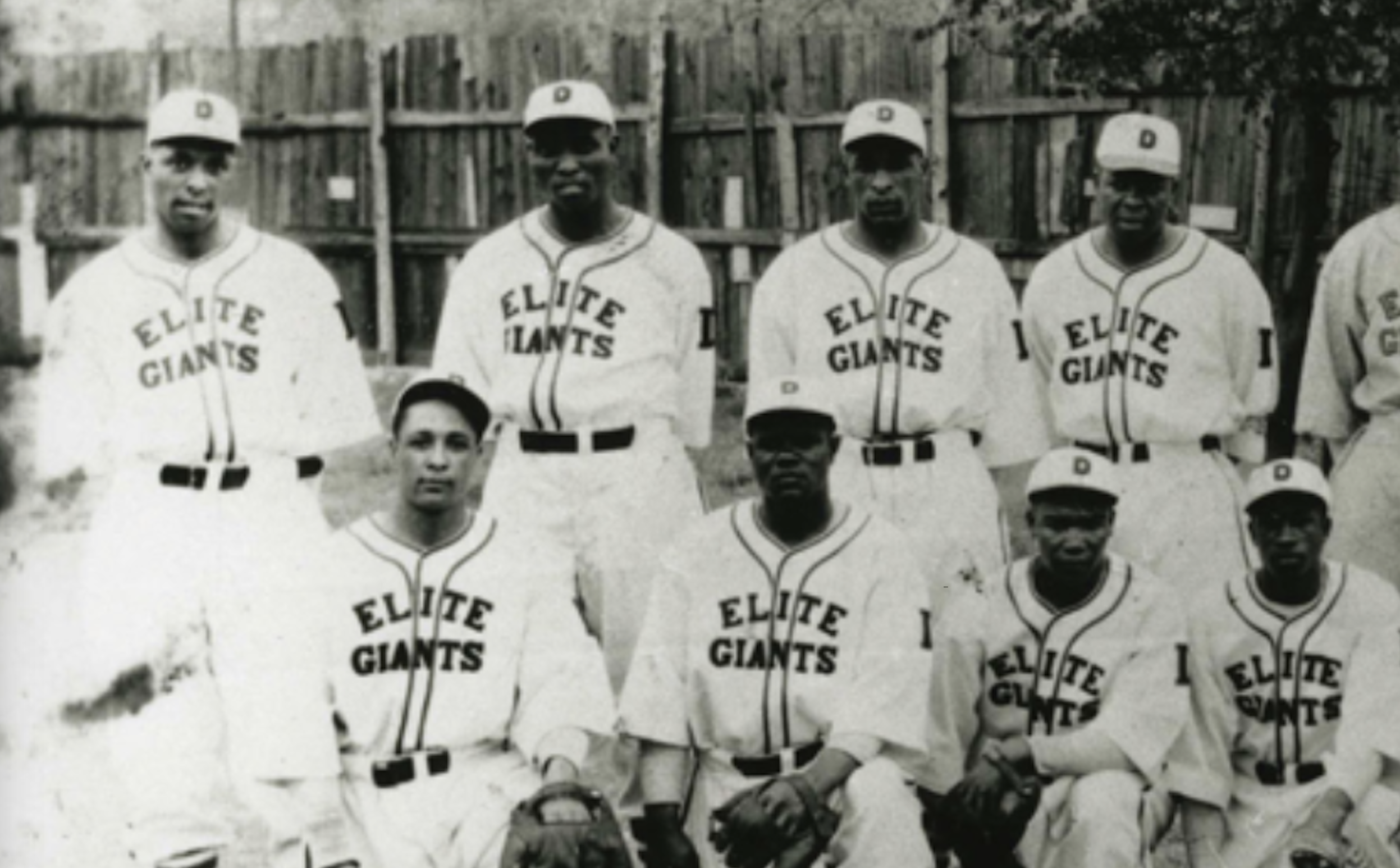
**–The image at the top of the post shows the 1935 Columbus Elite Giants, with Jim Willis in the bottom row, second from left. The “D” on their caps signifies Detroit, which was where the team was originally going to be based that year, before a deal to rent Hamtramck Stadium fell through.
Leave a Reply