From a recent issue of the Agate Type newsletter, here are four Negro league players I’ve recently identified or confirmed. I did this work back in September of this year.
- Edward Salter
- Nick Jones
- George Proctor
- Harlon Betts
1. Edward Salter
Salter was a baseball, football, and track and field star at Pontiac High School and then Western State Teachers College in Michigan before joining the Detroit Stars for the inaugural season of the Negro American League in 1937. An outfielder, he only played two known league games for the Stars before being let go in May. In his last recorded game, he homered over the left field wall in Hamtramck Stadium, scoring Turkey Stearnes ahead of him, to lead the Stars to a 10-3 win over the Cincinnati Tigers. Outside of his brief major league career, he played baseball for local Michigan teams, including the Michigan Colored Giants of Pontiac and the Detroit Quinn Stars. He also became a high school teacher and (briefly) a police officer in Pontiac. By 1942 he had moved to St. Louis, where he pursued his teaching career.
He’s quite easy to find in census and other records. Here, for example, is his World War II draft card:


And here’s his Find a Grave record:

So far the only image I’ve found of Salter is the above photograph of him as an older gentleman.
2. Nick Jones
He makes it into the Seamheads Database because he appeared in a couple of games for the Donaldson All Stars against Pollock’s Cuban Stars (a.k.a. the Cuban House of David) in 1932. Nicholas Josephus Jones was well-known as a star for Black teams in the upper Midwest in the 1920s and 1930s. Born in Arkadelphia, Arkansas, he was living in Sioux City, Iowa, by 1925, where that year he joined the semipro Sioux City Ghosts alongside several other well-known players, including Negro league outfielder Lou Dials and fellow Arkadelphian Codie Spearman.

An entry in the 1925 Iowa State Census, showing Nick Jones (the top name listed here, though hard to read) and several of his teammates on the Sioux City Ghosts, including Oland (Lou) Dials and Codie Spearman, living together in a boarding house in Sioux City.
Over the next decade Nick Jones built a reputation as a slugging outfielder for a number of teams across the upper Midwest, including the Ghosts, the Sioux City All-Stars, the Colored House of David (also headquarted in Sioux City), and the Donaldson All Stars. His teammates included the legendary, eponymous John Donaldson of the last-named team; Dave Brown, then in hiding and playing under the name “Lefty Wilson”; a bevy of St. Louis players such as the Watt brothers, Earl “Iron Horse” Harrison, and George Womack; and many other players who were well-known in the world of Black independent professional or semipro baseball in the West (Charlie Hilton, the Hancock brothers).
One early article claims that Jones played for the 1924 Memphis Red Sox, but this can’t be confirmed, and so far there is no evidence he ever played league baseball.


Jones played ball at least into the mid-1930s—in the Sioux City directory of 1932 and 1933 his occupation is still listed as “ball player.”

After baseball he lived in various places across the Northwest, finding construction, shipyard, and WPA work in Butte, Phoenix, and Seattle. Here is his mug shot from Washington state criminal records at Newspapers.com, taken after a minor fight evidently resulted in a knife injury to Jones (thus the head bandage).

He passed away in Salt Lake City in 1974.
3. George Proctor
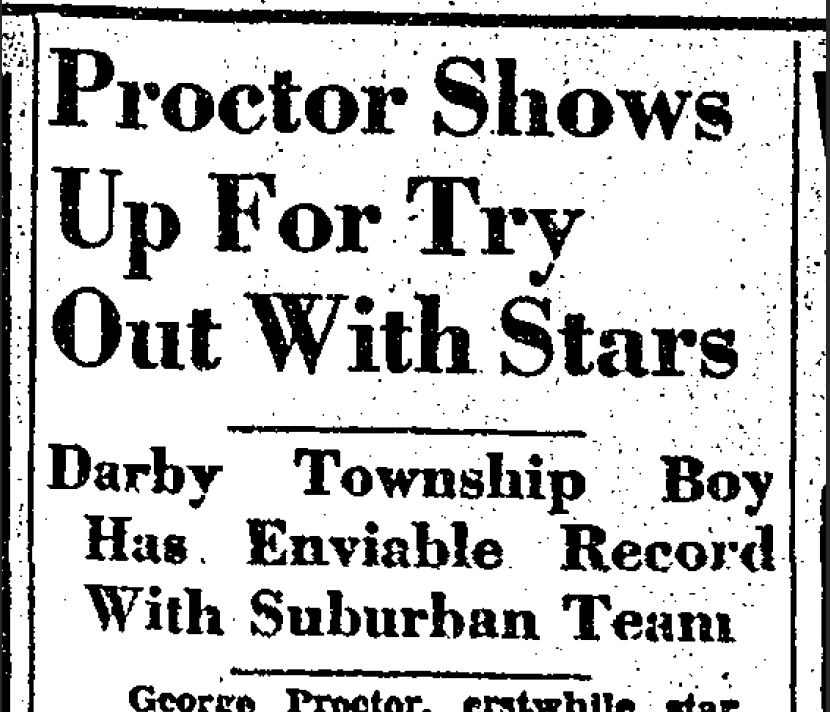
On July 16, 1938, in a letter to the Chester (Pa.) Times, Roscoe B. Coleman, executive director of the Darby Township Boys’ Club, touted Henry Miller, the star pitcher of the club’s baseball team (called the Oakeola Stars), who was now pitching pretty well in his rookie season for the Philadelphia Stars. In addition to Miller, Coleman hyped another pitcher, one George Proctor, who he said was scheduled for a tryout with the Stars soon. A few days later the Philadelphia Tribune followed suit with similar comments:

Philadelphia Tribune (July 21, 1938, p. 8)
By July 21, Philadelphia Stars owner Ed Bolden had summoned Proctor:

Philadelphia Tribune (July 28, 1938, p. 9)
It took a couple of weeks, but Proctor did eventually show up:

Philadelphia Tribune (August 11, 1938, p. 9)
And on September 3 he finally got a start, in Chester vs. the Baltimore Elite Giants. Unfortunately it didn’t go well, as the Elites treated Proctor and a reliever (Webster McDonald) badly and the Stars lost, 8 to 0.
This was the high point of his baseball career, although he did hover around the Philadelphia Stars over the next several years, appearing in at least one game (as a pinch-hitter) in 1940. He was pushed as a prospect for the Stars as late as 1945 by his erstwhile Darby Boys’ Club teammate (and by then Negro league veteran) Henry Miller:

Philadelphia Tribune (April 21, 1945, p. 12)
As a Darby Township native, George Proctor was relatively easy to find in census and other records, including his birth certificate and death records (though I don’t know where he is buried). Here, for example, is his World War II draft card:


I don’t have a baseball photo of him, but here is a high school photo, from Ancestry.com:

4. Harlon Betts
“Betts,” no first name, appears in both Peterson’s Only the Ball Was White (p. 316) and Riley’s Biographical Encyclopedia (p. 81) as an outfielder for the 1938 Kansas City Monarchs, with no other information. But Buck O’Neil remembered his teammate Harlon Betts, mentioning him in a 2003 talk in Spokane, Washington, where Betts’s widow and son lived then, 38 years after Harlon’s death.

John Blanchette, “Buck O’Neil earned right to be heard,” Spokane Spokesman-Review (February 16, 2003, p. 15)
Given this information, it was no problem to track down Harlon Betts. Sometimes called (like many other players) the “Black Babe Ruth” in local papers, he was a slugger who starred at first and third base for the Purcell (Oklahoma) Black Giants intermittently from 1935 to 1941. He earned a shot with the Monarchs as an outfielder in 1938, but didn’t extend his career at the top beyond that season. He served in the Army Air Force for three years in World War II, then moved to Lincoln, Nebraska, where he continued to play ball in the late 1940s. He passed away there in 1965.

Leave a Reply