(Originally published in the Agate Type newsletter.)
Here are some tid-bits and updates from recent research.
1. 1926 Bacharach Giants Revisited
While updating the 1926 ECL season for Seamheads, I ran across this photograph in the Atlantic City Press:

Which, of course, is the photo I discussed in this issue (also posted at my blog).

Contemporary captions for photographs are quite valuable. This one confirms all my IDs for players and identifies the one unknown player, the man standing third from right, who turns out to be pitcher/college coach Hubert Lockhart:

Here are a couple of other photos of Lockhart from the 1920s:

It also corrects my ID of the suited man standing in the middle of the back row, who is not Tom Jackson, but is rather John B. Dykes, treasurer of the Bacharachs. This one was a real mistake on my part, as I failed to realize that Jackson was not involved with the Bacharachs in 1926 (that year he promoted independent teams who played at Bacharach Park).

In addition, the caption identifies the suited man on the far right, who is a trainer named Butler. I haven’t been able to find out anything else about him, not even a first name (no mentions anywhere, in fact).

2. Dr. Cyclops
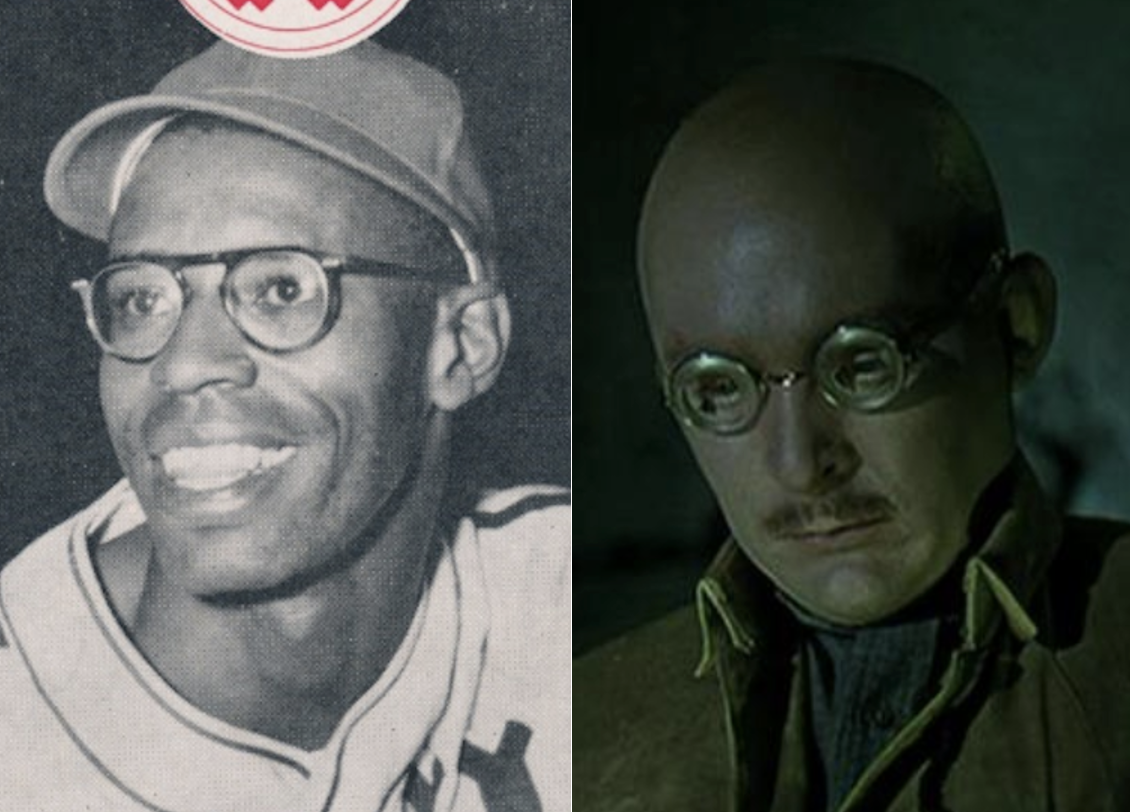
A few months ago I happened upon an ad for a schlocky sci-fi/horror movie in a 1940 issue of the Philadelphia Tribune—on the same page as a box score for a win by Max Manning of the Newark Eagles.

The movie, of course, was Dr. Cyclops. This also happens to be the nickname for Max Manning, due to his thick, coke-bottle glasses, which resembled the ones worn by the movie’s titular villain. According to Frederick C. Bush’s biography of Manning, it was his teammate Jimmy Hill who saw the movie and hung the nickname on him.
As I understand it (I haven’t seen the movie) the poor eyesight and spectacles of Dr. Cyclops provided some plot points, though they weren’t really the focus of the movie. His superweapon was a radioactive shrink ray, and his evil plan was…to shrink a bunch of people. Max also had a superweapon—his fast ball—and I suppose it shrank opposing batters down to size, but it’s hard to see him as a villain.

3. New Photos of the Week
Here are some player images I’ve scrounged up in the past few months. Page 10 of the May 30, 1942, Cleveland Call and Post featured several photos of Cleveland-Cincinnati Buckeyes players plus a team photograph (unfortunately not captioned).

In addition to infielder Tice James, outfielder Emmett Wilson, and player-manager Walter Burch, three fairly little-known players are pictured:

George Brown came to prominence on the Ethiopian Clowns under the nom de guerre “Tanna.” His signal accomplishment was winning a wristwatch for batting .545 in the 1939 Denver Post Tournament as the Clowns finished in third place. So far the commonness of his name and relative brevity of his career has kept him from being identified in records.

The photo of Brown’s teammate Dode Smith, with Smith’s face half-obscured by his windup, is emblematic of our lack of knowledge of him. Barely mentioned in papers at the time, and with only 3 innings pitched in games with box scores, Dode Smith is even more obscure than George Brown.

The pitcher Fred McKelvin came to spring training with the Buckeyes, but only got into one league game with them (no box score has been found so far). He later appeared in another league game that season with his hometown Jacksonville Red Caps. His baseball career was cut short by a manslaughter conviction in January 1943 for fatally shooting a man who seems to have been his roommate (though I have only found limited information about the incident).
Leave a Reply